
Industry Leaders Warn America Cannot Compete, Manufacture, or Lead in AI If It Cannot Build
CONTACT:
Chrissy Harbin, Miranda Dabney
WASHINGTON, D.C. — U.S. Senator Alan Armstrong (R-OK) called on Congress and industry leaders this week to seize a narrow window for bipartisan permitting reform, warning that America will lose investment, jobs, and its global competitive edge unless it becomes easier to build critical infrastructure.
Speaking before leaders from the energy, manufacturing, technology, and infrastructure sectors at a policy forum hosted by the American Council for Capital Formation (ACCF), Armstrong said the nation’s permitting system too often makes it easier to stop a project than to complete one.
“If we can’t change that culture of making it easier today to block a project than it is to build a project, we have a very serious problem down the road,” said Senator Armstrong. “Congress really has a very narrow window to enact meaningful bipartisan reform right now. It is making our country much less competitive if you don’t take this on. So if we cannot, we’re not going to continue to lead if we cannot build.”
The forum demonstrated a growing consensus across party lines and economic sectors: America’s broken permitting system is no longer simply a regulatory problem. It is a threat to national security, energy reliability, industrial growth, technological leadership, and American jobs.
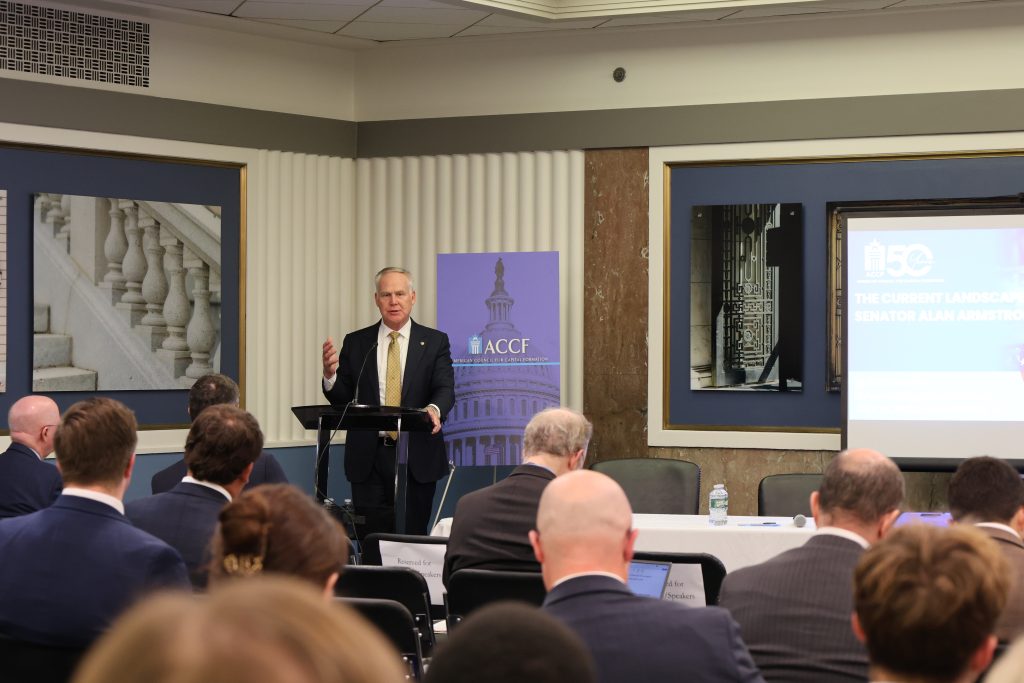
Senators Warn That America’s Inability to Build Has Become a Strategic Liability
Senators Kevin Cramer (R-ND), Mike Rounds (R-SD), Bill Cassidy (R-LA), and John Hickenlooper (D-CO) also joined the forum, outlining the mounting costs of permitting delays.
Senator Mike Rounds (R-SD) focused on the global artificial intelligence race, warning that “China is not sitting back” and does not face the same bureaucratic obstacles confronting American projects. He argued that the United States cannot lead in AI without rapidly expanding the reliable power generation and infrastructure needed to support data centers and advanced computing.
Senator Kevin Cramer (R-ND) connected permitting delays directly to the defense industrial base, citing local processes that have slowed space launches and missile testing. He warned that moving “slowly and deliberately” has become a strategic disadvantage when American adversaries can test, build, and deploy at scale.
Senator John Hickenlooper (D-CO) stressed the need for certainty as electricity demand accelerates. He argued that any durable reform must be comprehensive and include the transmission infrastructure—the “wires”—needed to meet projected load growth of 3 to 5 percent, driven in significant part by data centers.
Senator Bill Cassidy (R-LA) framed the issue around “jobs, jobs, jobs,” arguing that working families pay the price when delays push investment and manufacturing overseas. He also linked permitting reform to his foreign emissions fee proposal, noting that the United States cannot bring production back from China if companies cannot build facilities on a predictable timeline.
Energy, Manufacturing, and Technology Leaders Unite Behind Reform
The forum brought together an unusually broad coalition spanning renewable and traditional energy, advanced manufacturing, steel, critical minerals, utilities, technology, and infrastructure finance.
Participants represented Google, First Solar, Ørsted, National Grid, The Williams Companies, PBF Energy, Glencore, Emirates Global Aluminium, the American Iron and Steel Institute, the National Petroleum Council, the American Clean Power Association, ClearPath, the Business Roundtable, the Center for Industrial Materials, and other organizations across the industrial economy.
Their participation underscored a central message: permitting reform is not about choosing one industry, fuel, or technology over another. It is about enabling the United States to build the full range of infrastructure required for economic growth and national security—including power plants, transmission lines, pipelines, data centers, factories, mines, ports, and defense facilities.
Industry Leaders Praise Armstrong’s “Constructive Disruption”
Participants credited Armstrong with elevating permitting reform as a national priority and bringing together industries that have not always approached the issue from the same perspective.
“Senator Armstrong, you came here to be a constructive disruptor, and I think we would all agree that you have had that impact on this discussion,” said Jason Grumet, CEO of the American Clean Power Association.
Matt Sonnesyn, senior vice president of policy at the Business Roundtable, thanked Armstrong for his longstanding leadership on the issue. “He’s been a leader on this issue since well before he was a United States Senator,” Sonnesyn said. “We are so glad to see him here championing it now in Washington.”
Jim Connaughton, an ACCF distinguished fellow and event organizer, described Armstrong as a leading champion for economic growth, opportunity, national security, and abundant energy, adding that there is “no better leader” to carry the message of infrastructure acceleration.
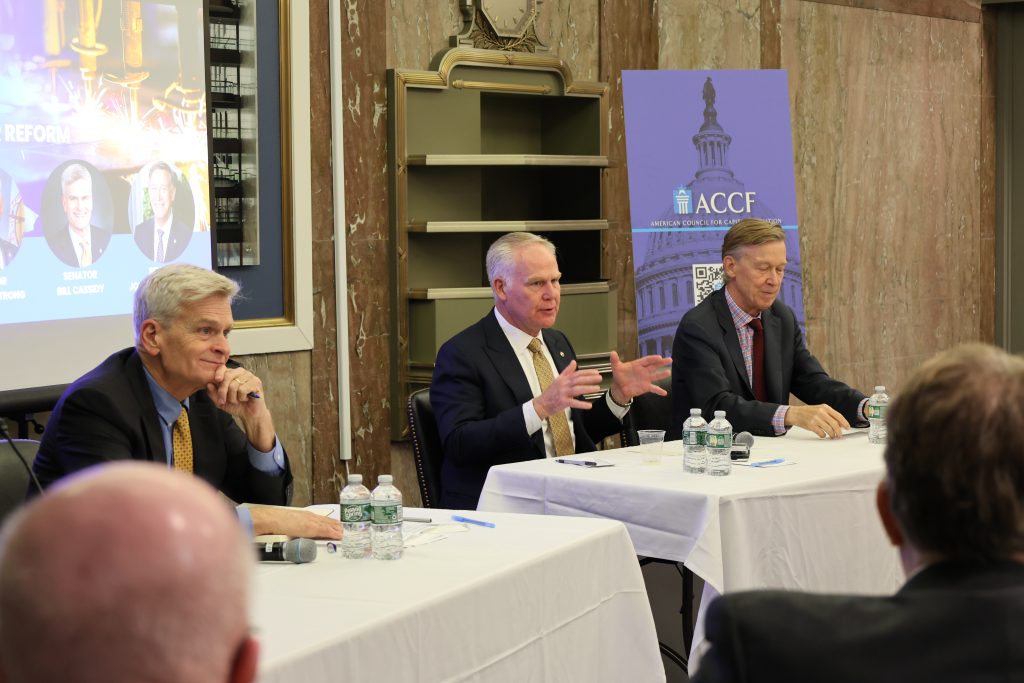
Armstrong to Industry: “Pound the Table”
Armstrong challenged executives and trade associations to move beyond statements of support and demand that Congress deliver meaningful reform.
“We really need industry pounding the table on this issue about how important it is,” Armstrong said.
He noted that industries are increasingly moving beyond narrow fights over individual projects and uniting behind a shared need for greater certainty, speed, and accountability.
Armstrong warned that continued inaction would normalize a culture in which blocking projects is expected—making it harder for the United States to attract investment, expand domestic manufacturing, strengthen its defense industrial base, and compete with China.
“If Not Now, When?”
Armstrong closed the forum by urging Congress to secure a meaningful down payment on reform before the end of the year. “Our country is not going to continue to be a place to invest if we can’t get our permitting process straightened out,” Armstrong said. “If we cannot build, we cannot continue to lead.”
More information on the policy forum can be found here.
Watch Senator Armstrong’s opening remarks here.